As an Amazon Associate, we earn from qualifying purchases. Some links on this site are affiliate links at no extra cost to you. Our recommendations are based on thorough research and editorial judgment.


Distance and Positioning: How Far Should Grow Lights Be From Plants

Proper grow light distance affects intensity and plant health. Seedlings need about 24–30 inches from LEDs to avoid light stress, while vegetative plants do best at 18–24 inches for compact growth and leaf development. Flowering or high‑light species should be 12–18 inches to reach 800–1,000 μmol/m²/s PPFD, with medium veg targets around 400–600 μmol/m²/s. Adjust for fixture wattage and beam width, watch leaf temperature and symptoms, and follow simple steps below to optimize placement and learn more.
Key Takeaways
- Seedlings: keep LEDs about 24–30 inches away to prevent light stress and leggy growth.
- Vegetative stage: position lights 18–24 inches for compact, healthy leaf development.
- Flowering/fruiting: move lights closer, about 12–18 inches, to increase bud and flower density.
- Use PPFD (μmol/m²/s) targets — 400–600 veg, 800–1,000 flower — and adjust height accordingly.
- Monitor plant response and canopy temperature; increase distance if yellowing, burning, or heat stress appears.
Why Grow Light Distance Matters for Plant Health
You may be interested


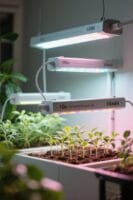
Because light intensity directly affects photosynthesis, proper grow light distance is a primary control for plant health. Growers should aim for an ideal distance that delivers appropriate PPFD, typically 400–1200 μmol/m²/s, to promote steady plant growth. Seedlings often need about 24–30 inches from the lamp, while flowering stage plants benefit from 12–18 inches for greater bud density and yield. Lights too far cause leggy stems from low light, and lights too close cause light burn, yellowing leaves, and stunted growth. Monitor ambient temperature inside a grow tent, because higher heat needs greater spacing to avoid heat stress. Use a PAR meter to measure PPFD and adjust height incrementally, testing for leaf response and canopy uniformity. Full spectrum coverage is essential for all plant growth stages and contributes to optimal light intensity management.
How Plant Type Changes Optimal Light Distance
Having established how distance affects light intensity and plant health, the next consideration is species-specific needs. Low light plants, like prayer plants and ferns, do better farther away, roughly 2 feet from LED grow lights, to avoid excess light intensity. Medium light species, such as Monstera, thrive at about 12–24 inches, which helps reach a Daily Light Integral near 10–15 Mol/m²/day for steady growth. High light plants, for example fiddle leaf figs, prefer closer placement, around 12–18 inches, to approach a DLI of 20–30 Mol/m²/day. Vegetables and herbs need medium to high light, 12–24 inches. Wattage and beam width of an ideal LED determine how close lights can safely be placed. Adjust distance based on observed plant response. Smart app integration allows for easy control over timing and brightness, helping to fine-tune light conditions for optimal plant growth.
Recommended Products

Architectural-Grade 304 Stainless Steel Construction for quality and years of dependable use!
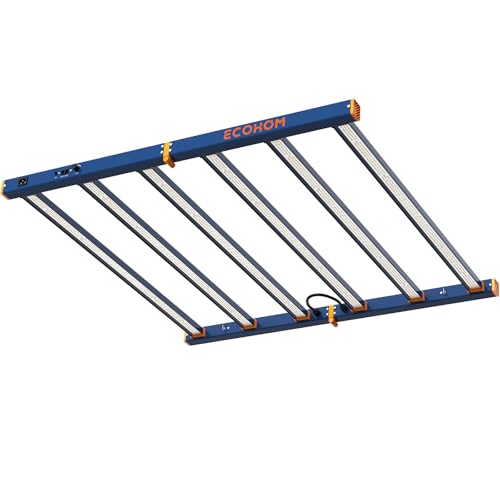
【High Efficiency and Energy Saving】The 720W led grow light is highly energy efficient. market-leading 2.8µmol/J PPE, Max 2.5g yield/watt, 720 watt with smaller footprint for better crop quality, more cost-effective. Our grow light can save more energy while maximizing plant growth and yield.

LED 300W Grow Light: light includes 100PCS x 3W LED chips, red,bule, purple and yellow chips used to featuring a user friendly "Full Spectrum" design, you can easily grow your plants in any growth cycle required like germination, veg, flower. 2 cooling fans on the top to blow out the heat when working. The lifespan is 5000hrs. When using it for different purpuse, you just need to adjust the height to the canopy according to the instruction sheet.
Light Intensity Metrics: PPFD, PPF and DLI Explained

When growers need to match light to plant needs, three metrics come to the rescue. PPFD measures light intensity at the canopy in μmol/m²/s, and it directly relates to photosynthesis rates, seedlings often need 100–300 μmol/m²/s. PPF quantifies total lamp output in μmol/s, useful for comparing fixtures regardless of placement, it does not tell how much reaches plants. DLI sums daily light exposure in mol/m²/day, combining PPFD over time to show total energy plants receive. These light metrics guide adjustments by growth stage, for example vegetative targets near 400–600 μmol/m²/s and flowering 800–1,000 μmol/m²/s. Understanding PPFD, PPF and DLI helps set ideal light distance to meet specific plant needs. For optimal indoor gardening, considering safety certifications like ETL or UL ensures the grow lights and timers used are reliable and safe for operations.
Recommended Distances by Growth Stage
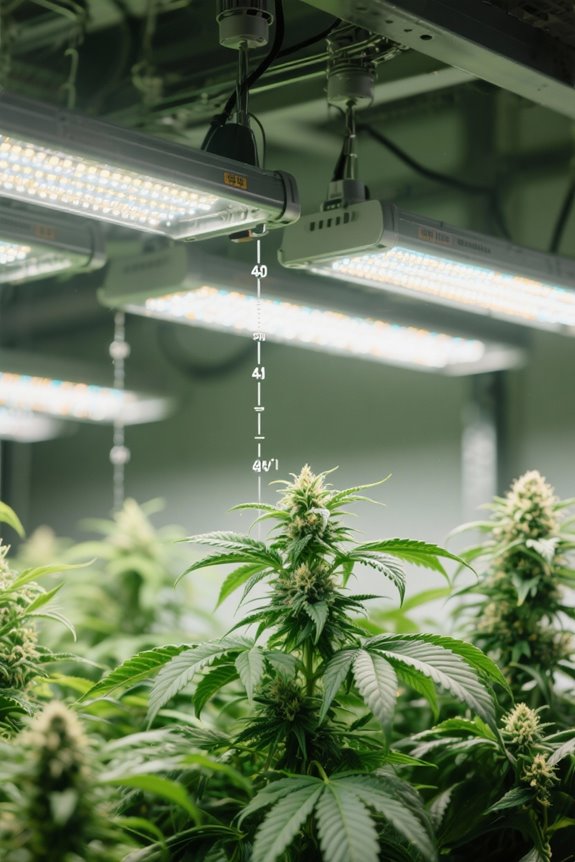
After explaining PPFD, PPF and DLI, the next step is to match those numbers to actual light placement above plants. Seedling stage requires about 24–30 inches between light and canopy to prevent light stress, and to promote sturdy early growth. Vegetative stage moves lights closer, roughly 18–24 inches, encouraging compact internodes and fuller leaf development while maintaining safe light intensity. Early flowering generally stays at 18–24 inches to support initial bud sites without leaf burn, adjusting as needed. Peak flowering benefits from 12–18 inches to increase flower density, but must be balanced against heat and intensity. Indoor plants vary, so monitor individual plant responses and fine-tune ideal positioning for each strain and environment. It is crucial to consider full spectrum lighting when positioning grow lights, as it affects both the growth stages and the overall health of the plants.
Recommended Products

Program and monitor using mobile app or onboard touchscreen

PREMIUM Foldable 1500W- LED lights specialty manufactured by Sinowell with Samsung LM301 diodes for FULL spectrum light, ideal for ALL STAGES of growth. Large 48x48 footprint for the best light spread and prenetration. Silent functions mean that no fans cause noise pollution in your home. 1500w output incentivizes low cost for the home and runs 50% less energy than “blurple” and other leading LEDs. UL, CE, ETL Certificated.

An advanced AI grow tent kit with dynamic controls and built-in components; everything you need to achieve the perfect grow—all housed in a state-of-the-art tent.
How Wattage and Beam Width Affect Placement
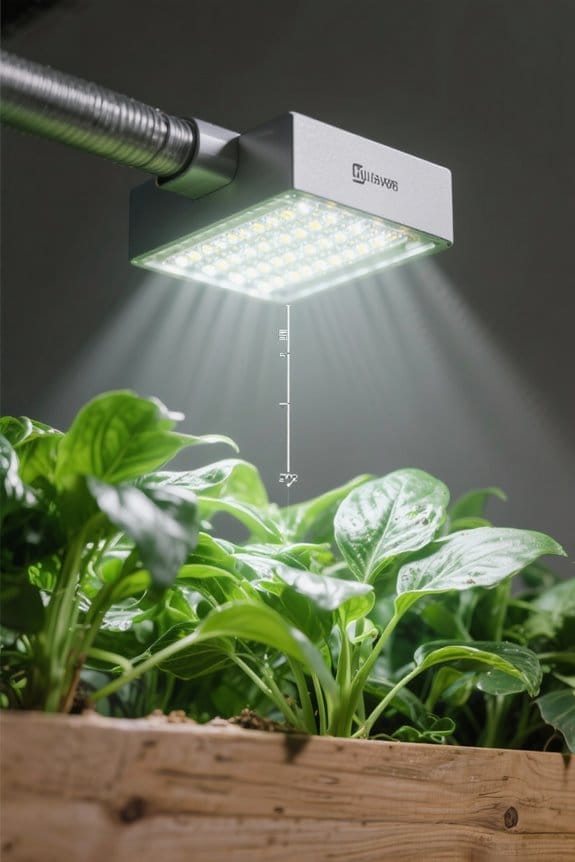
Because wattage and beam width determine how much and where light lands, growers should match those specs to plant needs before setting fixture height. Low wattage fixtures require closer placement, typically 12–24 inches, to meet basic light requirements without raising PPFD above target. Medium units sit around 18–30 inches, balancing spread and intensity for vegetative growth. High wattage systems can be mounted 24–36 inches away, providing higher PPFD across larger canopy areas. Beam width affects distribution; narrow beams concentrate light and raise local PPFD, so increase distance or use optics to widen coverage. Fixtures with lenses come to the rescue by maintaining efficiency at greater ideal distance. Proper adjustment of wattage, beam width, and placement preserves plant health and prevents light burn. Consider using full-spectrum LEDs which cover 400 nm to 700 nm to closely match natural sunlight, enhancing photosynthesis efficiency.
Recommended Products

🌞 TRUE SUNLIKE SPECTRUM – The first LED grow light engineered to replicate a real CMH-style sunlight spectrum. Balanced White, Green, Dual Red (640nm + 660nm), Far Red, and optional UV deliver unmatched canopy penetration and plant performance.

Features Samsung LM301H EVO LEDs each rated at 3.14 µmol/J PPE, the highest efficiency of LM301B, LM301H, and Bridgelux 3030 chips.

IP65 Water Resistant Rating: Features IP65 water resistant rating to protect the LED system from moisture and dust in grow environments
Temperature, Humidity and Leaf Surface Considerations
Having set wattage and beam width for proper PPFD, growers must also control temperature and humidity to protect leaf surfaces from heat injury. Leaf surface temperatures should remain below 29°C to prevent burning, so ambient temperatures dictate greater lamp distance when warm. Higher humidity reduces moisture loss, allowing closer light placement without inducing heat stress, while low humidity forces increased spacing. Use PPFD meters to measure light intensity at the plant canopy, and correlate readings with temperature and humidity to find safe light exposure. For example, at 26–28°C and 60–70% humidity, place LEDs 20–30 cm away; at 30°C and 40% humidity, increase to 40–60 cm. Monitor regularly, adjust for microclimates, and prioritize leaf surface protection. LED grow lights offer energy-efficient solutions for indoor gardening, with customizable timers enhancing management efficiency, allowing growers to optimize conditions for plant health.
Practical Steps to Measure and Adjust Light Height
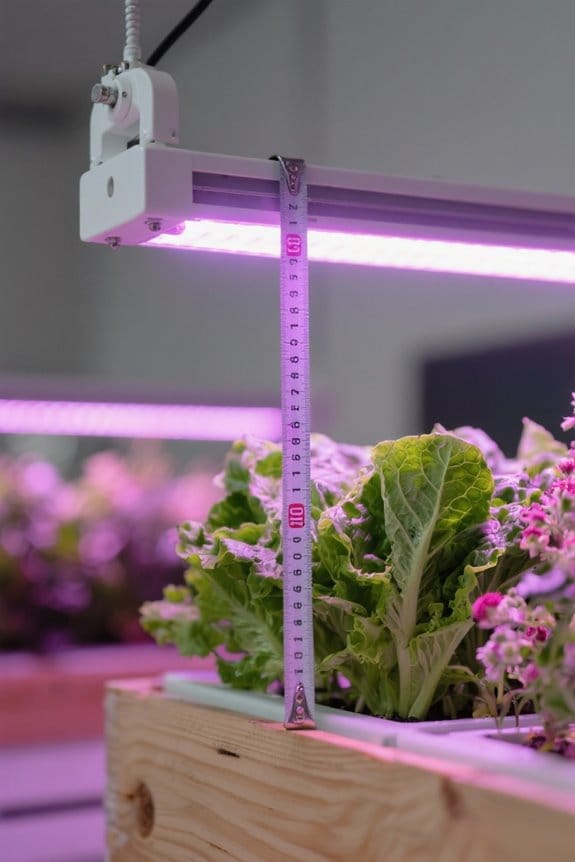
Start by measuring from the light to the plant canopy, not the pot, to get an accurate distance for intensity and heat control. Measure the distance between LED grow fixtures and the canopy with a tape measure. Use a PPFD meter to measure light intensity at multiple canopy points, this provides real PPFD maps for even coverage. For seedlings, set a correct distance of 24–36 inches targeting ~400 μmol/m²/s to prevent light stress. During vegetative growth lower to 12–24 inches for 400–800 μmol/m²/s, improving light penetration and compact form. In flowering, try 18–24 inches aiming 800–1200 μmol/m²/s for dense development. Recheck leaf temperature, adjust to maintain ideal grow light conditions and the ideal right amount of light for healthy plants.
Recommended Products
Sleek Design: The Beauty4U Glass Display Cabinet features a sleek and modern design that will enhance the aesthetic of any living room, bedroom, or office. The maximum load-bearing capacity of a single layer is 44LBS

【1080P HD Digital Wireless Camera & Stable Signal】 Enjoy crystal-clear 1080P images with our digital wireless backup camera system. Designed for RVs, trucks, trailers, and campers up to 60ft, it delivers a stable signal up to 980ft in open areas with no interference, ensuring safe reversing every time.
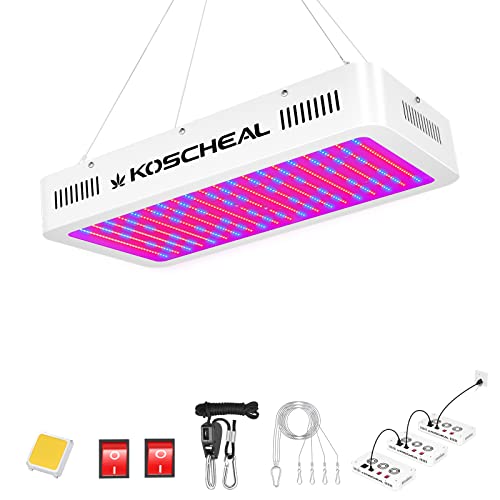
【230W High Yield & 2.8 µmol/J Efficacy】Outperform standard 200W lights. The KOSCHEAL KS2000 draws an actual 230 watts, utilizing upgraded SMD LEDs to deliver an impressive 2.8 µmol/J efficacy. It easily replaces a traditional 400W HPS/CMH setup, ensuring your indoor plants receive maximum PAR output for faster, heavier harvests while keeping electricity costs exceptionally low.
Placement Guidelines for Leafy Greens, Herbs and Vegetables
After measuring canopy distance and PPFD across the bed, growers should arrange fixtures to match leafy greens’ and herbs’ light needs. Place LED Grow Lights 24–36 inches above seedlings to prevent stress, this distance for your plants balances intensity and heat. As plants mature, drop fixtures to 12–24 inches, placing closer to reach 15–20 Mol/m²/day, the medium to high light intensity target for ideal growth. Aim for 400–600 μmol/m²/s PPFD during vegetative stages, photosynthetic photon flux density measures usable light. Monitor plants for leggy stems or small leaves as indicators of inadequate light. Adjust in 2–4 inch increments, allow 24–48 hours for response, and document settings to replicate successful runs.
Recommended Products
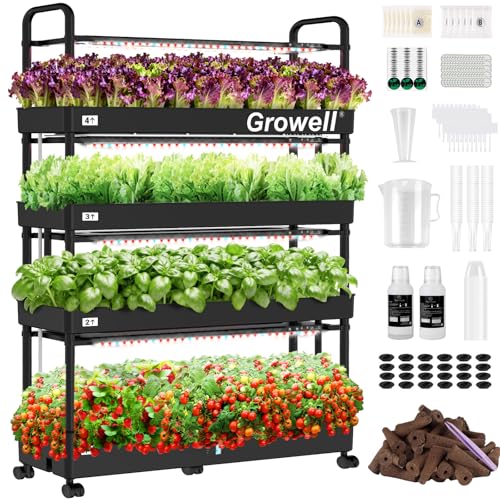
Large Hydroponics Growing System: Featuring 120 pods, the Growell vertical indoor garden allows you grow up to 120 plants at once, letting you cultivate vegetables, fruits, herbs, and flowers with ease. With a space-efficient size of 36.6''L*10.2''W*67.3''H, it maximizes yield while minimizing space. Compared to traditional soil gardening, it significantly reduces time, space, and water usage, speeding up growth cycles for efficient yields.
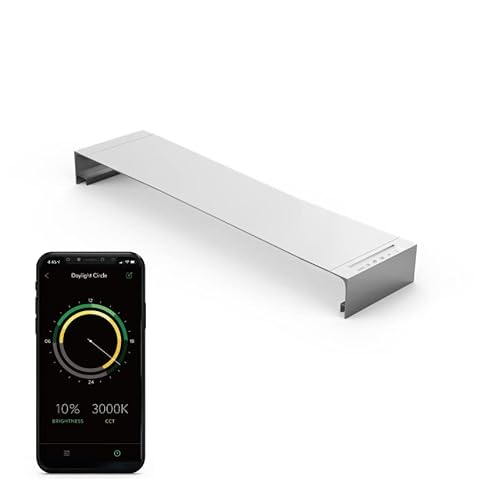
【Simulated Natural Light Cycle】 Features a fully adjustable 24-hour gradual light cycle, including sunrise, midday, sunset, and nighttime modes. This dynamic lighting replicates natural daylight patterns, supporting the biological rhythms of aquatic plants and freshwater species.

FULL SPECTRUM- Producing eye-popping color and amazing color rendition, full spectrum control allows you to create the perfect color spectra for your reef. A powerful blend of Dual Actinic blue 445nm/460nm, Dual Daylight white 6,700K/10,000K and RGB LEDs combined with 90° spherical optical lenses delivers the perfect blend of light for strong coral growth and amazing fluorescence.
Troubleshooting Common Light Distance Problems
When growers notice unusual leaf color or stretched stems, it often points to a problem with fixture height or light intensity. Yellowing often means plants receive too much light and heat; increase distance to prevent light burn, check LED spectrum and fixture distance. Leggy seedlings need more light; move grow light closer within the ideal distance of 24–30 inches for seedlings, avoiding stunted growth from excessive proximity. During flowering stage maintain 12–18 inches, closer can boost flower density but can cause foxtailing and burnt tips if PPFD exceeds safe levels. Regular monitoring PPFD with a meter comes to the rescue, keep light intensity under ~1,200 μmol/m²/s, adjust for spectrum LED grow characteristics and target light levels. An energy-efficient option not only reduces electricity costs but also lowers heat output, minimizing the risk of light burn on sensitive plants.
Frequently Asked Questions
How Close Should My Grow Light Be to My Plants?
A tiny sun on a string hovers humorously above sprouts; one recommends ideal distance by growth stages: consider light spectrum, heat management, plant types, light intensity, duration, energy efficiency, setup adjustments, and overall plant health.
How to Tell if Your Grow Light Is Too Close?
They observe light burn, yellowing leaves, leaf curling, heat damage or reduced growth rate; excessive light intensity or wrong light spectrum causes stretching plants and poor plant health, increasing energy consumption while signaling repositioning is needed.
Can Plants Get Too Much Light From Grow Lights?
Yes; plants can receive too much light. Excessive light intensity, prolonged light duration, inappropriate light spectrum or frequency, improper light types and heat emission harm plant growth and health, while reflection and growth phases dictate safe exposure.
How Close Should a 100 Watt LED Grow Light Be to a Plant?
About 18–24 inches vegetative, 12–18 inches flowering. A 100W LED’s wattage effect influences plant health; monitor light spectrum, light distance and fixture height for light uniformity, heat reduction, energy efficiency, growth stages, and adjustment tips.


