As an Amazon Associate, we earn from qualifying purchases. Some links on this site are affiliate links at no extra cost to you. Our recommendations are based on thorough research and editorial judgment.


How Grow Lights Work: Understanding Light Spectrum for Plant Growth

Grow lights supply photosynthetically active radiation (PAR), the 400–700 nm band plants use for photosynthesis. They mix blue (400–500 nm) for compact vegetative growth and red (600–700 nm) for flowering, often adding UV and far‑red to influence flavor and morphology. Intensity is measured as PPFD in µmol·m⁻²·s⁻¹, with seedlings needing ~100–300 and flowering up to 600–1000. LED efficacy is PPE in µmol·J⁻¹, 1.5–3.0 typical, and practical setup tips follow.
Key Takeaways
- Plants use PAR (400–700 nm) light for photosynthesis; grow lights supply photons in this range to drive growth.
- Blue light (400–500 nm) promotes compact, leafy vegetative growth and strong chlorophyll production.
- Red light (600–700 nm) stimulates flowering, fruiting, and biomass accumulation during reproductive stages.
- Full-spectrum LEDs mimic sunlight (including some UV and far-red) to support all plant stages and secondary metabolite development.
- PPFD (µmol/m²/s) and PPE (µmol/J) measure usable light intensity and efficiency, guiding distance and runtime for optimal growth.
What Light Spectrum Means for Plants
You may be interested


When choosing grow lights, understanding the light spectrum helps match lamps to plant needs. The light spectrum spans roughly 400nm to 700nm, called Photosynthetic Active Radiation, which plants require for photosynthesis and growth. Blue light (400–500nm) promotes compact, leafy vegetative growth, useful for seedlings and leafy crops. Red light (600–700nm) drives flowering and fruiting, essential during reproductive stages. UV light (100–400nm) can stimulate secondary metabolites, improving flavor and plant health in measured doses. Full spectrum grow light fixtures replicate sunlight by combining blue, red, and intermediate wavelengths, coming to the rescue when natural light is insufficient. Adjusting light wavelengths and durations, calibrated to species and stage, improves plant growth and crop yields. Modern grow lights, like the Yadoker Plant Grow Light, offer full spectrum coverage essential for plant growth throughout all stages, effectively mimicking natural sunlight when indoor conditions are less than ideal.
Photosynthetically Active Radiation (PAR) and PPFD Explained

A useful starting point is understanding PAR, the band of light from 400 to 700 nanometers that plants actually use for photosynthesis. Photosynthetically active radiation, or PAR, covers blue light and red light, both important for plant growth. Photosynthetic Photon Flux Density, abbreviated PPFD, measures how many photons in that PAR band hit a square meter each second, expressed in µmol m-2 s-1. Higher PPFD generally increases photosynthesis and growth, up to species-specific limits where light saturation or damage can occur. Seedlings often need lower PPFD with relatively more blue light for compact development, while flowering stages benefit from stronger red light and higher PPFD. Determining ideal PPFD requires considering plant type, growth stage, and environment, guiding growers to set appropriate light intensity. Full spectrum lights in the 4000K to 6000K range can simulate natural sunlight, supporting all stages of plant growth for indoor gardens.
Key Wavelengths: UV, Blue, Red and Far‑Red Roles

Understanding light by wavelength helps growers match lamps to plant needs. UV light (100–400 nm) comes first, and it boosts secondary metabolites that improve crop quality and flavor, useful at low doses. Blue light (400–500 nm) promotes vegetative growth and flowering, increasing chlorophyll production for efficient photosynthesis. Red light (600–700 nm) is highly effective for photosynthesis, driving biomass accumulation and flowering when supplied at high photon fluxes. Far-red light (700–800 nm) affects extension growth, changing leaf size and plant height, and can be used to manipulate canopy structure. Combining UV, blue, red, and far-red light across the light spectrum enhances photomorphogenesis, so tailored light recipes, with measured photon fluxes, solve specific plant growth problems. Full spectrum light options provide a balanced mix of these wavelengths, supporting various plant stages from seedling to flowering.
Recommended Products

PREMIUM Foldable 1500W- LED lights specialty manufactured by Sinowell with Samsung LM301 diodes for FULL spectrum light, ideal for ALL STAGES of growth. Large 48x48 footprint for the best light spread and prenetration. Silent functions mean that no fans cause noise pollution in your home. 1500w output incentivizes low cost for the home and runs 50% less energy than “blurple” and other leading LEDs. UL, CE, ETL Certificated.

🌞 TRUE SUNLIKE SPECTRUM – The first LED grow light engineered to replicate a real CMH-style sunlight spectrum. Balanced White, Green, Dual Red (640nm + 660nm), Far Red, and optional UV deliver unmatched canopy penetration and plant performance.

Features Samsung LM301H EVO LEDs each rated at 3.14 µmol/J PPE, the highest efficiency of LM301B, LM301H, and Bridgelux 3030 chips.
Full‑Spectrum LEDS Vs Narrowband Lights

Although growers often select lamps for short-term gains, choosing between full-spectrum LEDs and narrowband fixtures requires matching light output to plant needs over the whole crop cycle. Full-spectrum LEDs mimic sunlight by emitting ultraviolet through infrared, covering visible light bands at roughly 380–740 nm, and support photosynthesis and other physiological processes across stages. Narrowband lights emit focused wavelengths, for example 450 nm blue or 660 nm red, and come to the rescue for targeted responses like compact vegetative growth or flowering induction. Full-spectrum LEDs suit varied plant requirements and often improve crop yield and quality. Narrowband lights can be more energy efficient for specific applications, using 1.5–2.0 µmol/J designs to save electricity in controlled environments. LED grow lights can significantly reduce energy consumption compared to traditional lighting solutions, providing both cost savings and environmental benefits.
Recommended Products

IP65 Water Resistant Rating: Features IP65 water resistant rating to protect the LED system from moisture and dust in grow environments

【Maximize Yield & Crop Quality】The GP-4800 LED grow lights adopted with upgraded Samsung 281B ProVL & Osram 660nm chips in 6 passive-cooled led bars, professional SMD design offers even and broad canopy coverage, higher light intensity, less light decay. It's easily to achieve Max 2.9g yield per watt with 30% higher average PPFD, and boast the incredible high efficiency 2.9 µmol/J. Total 2016pcs LEDs consume 480W only over 4x4ft planting area, smaller footprint for better crop quality&quantity.
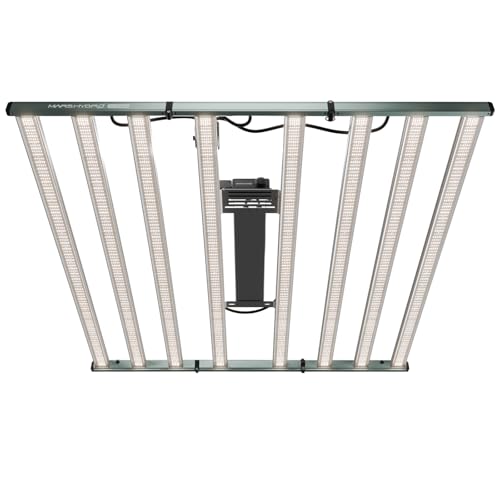
PRO PERFORMANCE & YIELD: Powered by premium Bridgelux 3030 diodes to deliver an impressive 2.9 μmol/J PPE. This high-efficiency 1000W grow light enhances par output, drives bud weight & increases overall crop density for indoor growing.
Matching Spectrum to Plant Species and Growth Stages

When matching light to a crop, growers should plan spectrum changes for each growth stage. Seedlings need higher blue light intensity (400–500 nm) to develop compact, sturdy stems and avoid legginess. During vegetative growth a balanced light spectrum with moderate blue and red supports leaf expansion and root development. Flowering and fruiting benefit from increased red wavelengths (600–700 nm), which promote blooming and seed set. Different plant species require adjustments; for example, flowering ornamentals and many fruiting crops need more red, while greens favor blue-rich mixes. Cannabis cultivation often uses fixed ratios of blue:red that shift between stages to influence yield and THC. Photosynthesis efficiency improves when spectrum, light placement, and timing match species-specific growth stages and PAR needs. Full spectrum lighting mimics natural sunlight, essential for healthy plant transitions and promoting flowering outcomes with necessary wavelengths like red and blue light.
Measuring and Optimizing Light: PPE, Kelvin and Sensors
To dial in lighting for crops, growers must measure both how much usable light a fixture produces and the quality of that light. PPE, photosynthetic photon efficacy, indicates µmol of PAR per joule, and higher PPE means more efficient grow lights, for example 2.5 µmol/J is strong. PPFD measures light intensity at the canopy in µmol/m²/s, and common targets range from 100 to 1000 µmol/m²/s depending on species. The Kelvin scale describes color temperature, 2700K for flowering, 5000–6500K for vegetative growth, and affects light spectrum balance. Light sensors come to the rescue, reporting PPFD and spectrum data so growers can adjust timing, fixture height, and mix of LEDs. Tracking PPE, PPFD, and Kelvin enables systematic optimization of plant growth. Additionally, energy-efficient LED grow lights help reduce electricity costs while providing necessary lighting for healthy plants.
Practical Guidelines for Indoor and Greenhouse Lighting
Having measured PPE, PPFD, and Kelvin, growers can now apply those metrics to practical lighting setups for indoor and greenhouse spaces. Use full-spectrum grow lights to cover the 400–700nm light spectrum, which supplies photosynthetically active radiation for ideal growth. Position LED grow lights about 6 inches above seedlings, and fluorescent fixtures roughly 12 inches away, to prevent stress while maintaining light intensity. Target photosynthetic photon flux density levels appropriate to species, increasing PPFD for flowering stages where red and blue balance shifts toward red (600–700nm). Maintain light duration of 12–16 hours daily, adjusting blue-dominant output for vegetative stages. Monitor and tweak placement, spectrum, and duration systematically to achieve consistent plant growth and efficient energy use.
Recommended Products

【MAXIMUM UNIFORMITY & EFFICIENCY】 The Spider Farmer G1000W LED Grow Light delivers unmatched power with 1000 watts and an innovative 8-bar design that extends light coverage to the edges for superior penetration and uniform distribution. Featuring high-efficiency Bridgelux diodes, it produces an output of 2940 µmol/s with an impressive PPE of 2.9 µmol/J. Ideal for commercial vertical grows in a 4x4ft space or a 5x5ft grow tent, especially when used with CO2 supplementation for peak performance

UPGRADED SPECS, BEST VALUE: The upgraded FC-E1000W now features an enhanced OSRAM red spectrum to maximize flowering—without the premium price tag. Built with high-efficiency Bridgelux LEDs, it delivers a powerful, uniform output that rivals top-tier lights. It remains the ultimate best-value choice for boosting yields while staying on budget.

HIGHEST EFFICIENCY FARMING LIGHTS: Agricultural LED lights have a high output of 1529 PPF at 2.60 μmol/j, making this one of the highest efficiency grow lighting on the market, with third-party lab results to prove it. This vegetation light is custom designed to fit a 4x4 ft grow tent perfectly, or wherever else your plants’ happy place happens to be; ETL/UL Certified
Frequently Asked Questions
What Light Spectrum Is Best for Plant Growth?
Balanced brilliance bestows benefits. It states red light and blue light optimize chlorophyll absorption and the photosynthesis process; growers match light wavelengths to plant types for indoor gardening, weighing grow light benefits, energy efficiency and light duration.
How to Tell if Grow Light Is Full Spectrum?
Check manufacturer specs for LED technology, color temperature and PAR range; confirm blue/red balance for growth stages. Assess light intensity, light duration, heat output, shadow effects, and energy efficiency to predict plant types’ growth rate.
How Do Full Spectrum Grow Lights Work?
Like a symphony, it emits balanced wavelengths: Types of bulbs vary, Light intensity and Energy efficiency optimize Plant growth phases; Blue light benefits leafing, Red light advantages flowering, UV exposure effects aid resilience; Grow light positioning, Timer settings, Cost comparison considered.
Do You Need Full Spectrum Lights to Grow Plants?
No, they are not strictly required. The observer notes LED lights offer energy efficiency and benefits comparisons favor full spectrum for diverse plant types and growth stages, optimizing photosynthesis process, light intensity, flowering needs, indoor gardening, and cost considerations.


