As an Amazon Associate, we earn from qualifying purchases. Some links on this site are affiliate links at no extra cost to you. Our recommendations are based on thorough research and editorial judgment.


The History and Evolution of Decorative Outdoor Lighting

Decorative outdoor lighting began with torches, oil lamps and candles offering 2–30 lumens, suited to short distances. In the 1800s, 3–4 m gas lampposts provided 5–15 lux on pavements, improving safety and nightly commerce. Electrification brought incandescent and fluorescent lamps with higher lumen output and 50–100 lm/W efficiency. LEDs arrived later, delivering 80% lower energy use and 25,000+ hour lifespans, plus smart controls for dimming and color. Continue for practical guidance on fixtures, IP ratings and placement.
Key Takeaways
- Early outdoor illumination used torches, oil lamps, and candles, balancing portability with limited lumen output and wind vulnerability.
- Nineteenth-century gas lighting expanded public safety and commerce, introducing decorative lampposts and consistent 5–15 lux pavement illumination.
- Electrification replaced gas with incandescent and fluorescent lamps, improving visibility, efficiency, and enabling varied ornamental streetlight designs.
- LED technology brought dramatic energy savings, long lifespans, color control, and smart remote management to decorative outdoor lighting.
- Contemporary design emphasizes layered lighting, warm high-CRI LEDs, appropriate IP ratings, and fixture scale to enhance landscapes and architecture.
Early Methods of Outdoor Illumination: Torches, Oil Lamps, and Candles
You may be interested
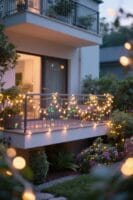


Many early outdoor lighting solutions relied on simple tools and predictable fuels. Torches provided directional outdoor illumination over short ranges, often 2–5 meters of useful light, and were easy to make from resinous wood. Oil lamps burned fish or whale oil in clay or stone bowls, producing about 5–20 lumens depending on wick size, and required trimming every 2–4 hours. Candles offered portable light, typically 10–30 lumens, but melted quickly in wind. Open flames required vigilant maintenance and posed clear safety risks like fires and smoke inhalation, so users applied shields and wind guards. Energy-efficient LED lights have transformed modern outdoor lighting by reducing electricity costs and enhancing brightness. Decorative gas lamps appeared later in the 19th century, adding design to urban settings. These shifts illustrate incremental lighting technology improvements and practical trade-offs.
The Gas Lighting Revolution in the 19th Century

When cities needed brighter, more reliable night illumination, gas lamps came to the rescue. Gas lighting spread in the 19th century, beginning with London in 1807 and Baltimore in 1816, then Paris by 1820. It made public spaces safer and extended commercial hours. Lamps delivered consistent illumination of roughly 5–15 lux on pavements, superior to candles. Fixtures paired artistry with functionality; cast-iron posts stood 3–4 meters tall and housed mantles or burners. In the Victorian era, decorative outdoor lighting displayed scrollwork and frosted glass to diffuse light evenly. Installation required pipelines delivering coal gas at about 20–30 mbar, valves, and periodic maintenance to clean sooty deposits. This practical system shaped urban landscapes, guiding designers who balanced style, specification, and municipal needs. A modern equivalent to enhancing outdoor spaces, outdoor fairy lights offer versatility and ambiance through their customizable lighting modes and weather-resistant designs.
Electrification and the Rise of Incandescent and Fluorescent Lights

A clear shift to electric power transformed outdoor lighting in the early 20th century. Cities moved from gas to electrification, enabling consistent lumen output and easier maintenance across blocks. Incandescent bulbs, with tungsten filaments typically 1–2 mm thick, became common by 1930, improving visibility and public safety on streets. Irving Langmuir’s coiled filament increased life to several hundred hours and raised lumen efficacy modestly. In the late 1920s fluorescent bulbs, using phosphors to convert ultraviolet to white light, appeared in Europe as higher-lumen-per-watt alternatives, offering roughly 50–100 lm/W versus 10–20 lm/W for incandescents. Outdoor lighting fixtures adapted, creating decorative streetlights that balanced aesthetic appeal and functional illuminance, 5–20 lux for sidewalks, 20–50 lux for roadways, guiding fixture choice and placement. Modern LED grow lights have further revolutionized lighting efficiency, offering significant energy savings and customizable spectrum outputs for various applications.
The Emergence of LEDs and Modern Energy-Efficient Technologies

Several decades of semiconductor research led to practical light-emitting diodes (LEDs) for general lighting. LEDs originated with red diodes in 1962, progressed to white LEDs in the 1990s, and transformed outdoor lighting options. LED technology uses semiconductor junctions to emit light, consuming up to 80% less energy than incandescent bulbs, lowering energy consumption from typical 60–100 W equivalents to 8–20 W. Their long lifespan often exceeds 25,000 hours, reducing replacements for landscape design and lighting fixtures. Modern systems integrate smart technology for remote control and color adjustments, improving functionality with aesthetic appeal without complex wiring. These advancements in outdoor lighting suit varied outdoor environments, from pathway lights to flood fixtures, providing measured illumination and predictable maintenance schedules. The integration of full spectrum lighting in LED technology enhances plant growth by mimicking natural sunlight, supporting both aesthetic and functional uses in outdoor environments.
Design Trends and the Aesthetic Role of Decorative Outdoor Lighting

Design considerations guide choices for decorative outdoor lighting. Designers select lighting solutions that balance form and function, using modern landscape lighting to highlight focal points like trees, paths, and walls. Fixtures vary by style and size, for example 4–6 inch path lights or 12–18 inch wall sconces, chosen to match fixture styles and aesthetic preferences. LED technology comes to the rescue with 2700–3000K warm options, 80+ CRI, and 5–15 watt outputs replacing 40–75W incandescent equivalents. Design trends favor layered lighting, combining uplights, downlights, and ambient washes to create depth and ambiance across outdoor spaces. Energy efficiency is described numerically in lumens per watt, and dimming controls, color temperature, and placement guide cohesive, functional decorative outdoor lighting schemes. For outdoor applications, it’s important to consider the IP rating to ensure the lights are protected against weather conditions and last over time.
Installation, Maintenance, and Choosing the Right Fixtures
Moving from aesthetic choices into practical work, installation, maintenance, and fixture selection complete the lighting plan. Install decorative outdoor lights with a layout plan, placing fixtures 6–10 feet apart for path lights and 8–12 feet for accent uplights, to guarantee proper performance and uniform illumination. Follow local building codes, bury wiring 18 inches where required, and use outdoor-rated fixtures and GFCI-protected circuits for safety. Schedule maintenance twice yearly, cleaning lenses, replacing bulbs, and checking seals to prevent corrosion and light loss. When choosing the right fixtures, consider lumen output, color temperature, and energy efficiency, for example 300–800 lumens and 2700–3000K for warm ambiance. Seek professional consultation for complex systems, timers, dimmers, or smart integration. Many battery-operated lights boast waterproof designs, ensuring durability for outdoor use in various weather conditions.
Frequently Asked Questions
How Has Lighting Changed Over Time?
Lighting evolved from primitive flames to sophisticated systems; historical influences shaped design trends, material choices and installation methods. Outdoor applications now emphasize energy efficiency, smart technology, solar options, aesthetic preferences and reduced environmental impact.
What Is the History of Porch Lights?
Like a lantern guiding time’s march, history shows porch light designs evolving from early lighting sources and Victorian porch aesthetics to electric porch lights, decorative lamp fixtures, porch lighting styles, porch safety lighting, energy efficient options, smart porch lights, historical significance.
What Is the History of Lighting Design?
Lighting design evolved from ancient illumination and historical lighting practices through industrial innovations and architectural influences, shaping ambient aesthetics and decorative styles; it reflects cultural significance, embraces technological advancements and sustainability practices, and anticipates future trends.
What Is the Most Significant Change in Lighting Design in the Past 20 Years?
“Necessity is the mother of invention”: the most significant change is LED innovation, enabling energy efficiency, smart technology, color temperatures and design versatility, reshaping aesthetic trends, installation methods, outdoor ambience, solar power integration and reduced ecological impact.


